|
The Nunnaminster, later known as St Mary's Abbey, was one of Winchester's three great Late Saxon royal monasteries. Founded by Queen Ealhswith, Alfred the Great's wife, in 903, it became one of the foremost centres of learning and art in England. In 964, the Nunnaminster, Old Minster, and New Minster were brought into a single enclosure to ensure isolation from the growing city. As part of this reorganisation, most of the monastery was rebuilt.
|


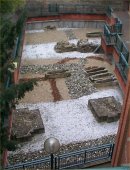


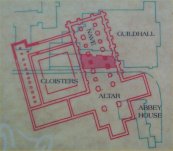
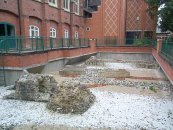
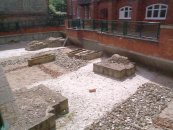

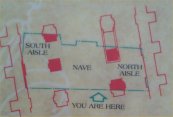
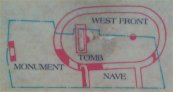 The earliest remains uncovered during the excavations were part of Ealhswith's Monastic church Circa 903 (Marked in red). Most of it had been destroyed by foundations of the later churches that were cut through it. The surviving walls suggest that the church was built of timber, resting on stone foundations. The nave was about 6.5m wide with a grand double-apsidal ceremonial entrance at the West Front. A tomb found in the southern apse may be that of St. Edburga. To the south of the church was a masonry base, perhaps for a monument or churchyard cross.
 t of Bishop Ethelwold's reforms to the City's monasteries, the boundaries of the Nunnaminster were reorganised and the church rebuilt. Ethelwold's new church (Marked in red) was about the same size as Ealhswith's, but it was built of stone supported on broad foundations. inside the church was a feature thought to be a double tomb. To the South were the Cloisters, a feature apparently absent from the earlier monastery.